PR + PLOT TWISTS™: Kevin Hart — Netflix Is a Joke… Or Is It?
When Every “Joke” Is A Receipt, Every Outfit Is A Signal, And Every Smile Looks Like A Contract Being Paid

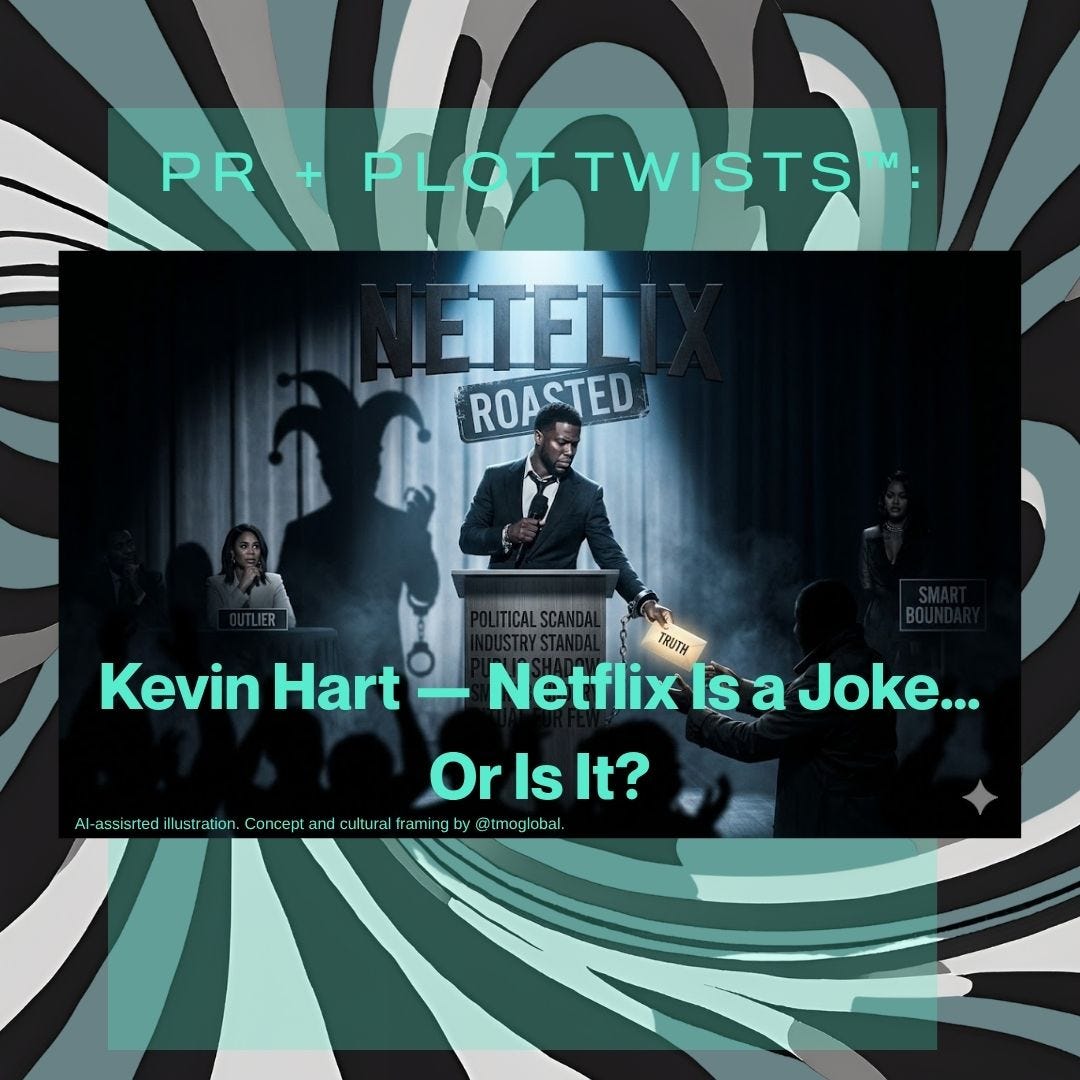
The first thing I noticed during Kevin Hart’s Netflix Is a Joke Roast was the symbolism not the jokes.
Kevin, his wife, and Dwayne “The Rock” Johnson all wore the exact same diamond necklace. Identical cut. Identical shine. Identical placement. Kevin and The Rock were even styled in almost the same silhouette. That is not fashion. That’s alignment.
In Hollywood, matching adornment is never accidental. It signals narrative pairing, contractual unity, or a coordinated storyline. So when Katt Williams made his “bromance” speech, it wasn’t random; it was his signature style of saying the quiet part out loud and the industry’s favorite way of exposure without ever having to own it.
But the symbolism didn’t stop there.
Nearly everyone positioned closest to Kevin carried some kind of public shadow: political scandal, industry scandal, moral scandal, or a long history of being adjacent to controversy. If you doubt it, go look it up. Except Regina Hall. She was the lone outlier, the only one whose public record is relatively clean, whose brand is not built on chaos, and whose energy did not match the ritual unfolding around her. Or did it?
Watching her deliver her lines felt less like comedy and more like someone reading from a line in her personal diary, with an invisible “or else” hovering just offstage. Teyana Taylor, equally perceptive, arrived, performed, and left immediately. A smart boundary.
And then there was the timing. The roast aired at the exact moment Kevin’s business turmoil was surfacing publicly, alongside the announcement of his new Netflix partnership, positioned as a career rebrand. That is not nothing.
Roasts tend to appear at inflection points. Career resets. Contract closures. Moments when the industry wants something from you. This did not feel like a celebration. It felt like a public humbling. A humiliation ritual disguised as entertainment, where the truth is smuggled in through humor and the people on stage pretend not to notice, even though their body language tells the truth.
The Women in the Room Told the Truth First
If you want to know what was really happening in that room, watch the women. Kevin’s wife laughed, but her body did not agree. Regina Hall half-smiled, but her eyes were terrified. Even a few of the women comics carried a tension that did not match the rhythm of the jokes. Tiffany Haddish was mysteriously spared from any insults at all.
Their discomfort was not about the content. It was the energetic mismatch, the knowing that something in the room was off and the humor was a cover.
Women do not flinch at jokes.
Women flinch at truths dressed as jokes.
On that stage, the truths were loud.
The laughter was the only thing forced.
PLOT TWIST: The Audience Was Not Innocent. They Were Participatory.
This wasn’t a passive audience.
This was a room filled with industry insiders, recognizable faces, and people who understand exactly how Hollywood works. Their laughter wasn’t naïve; it was complicit. They weren’t responding to comedy; they were participating in a cultural performance where everyone knows the rules:
The jokes are coded.
The truths are intentional.
The discomfort is part of the offering.
And the audience’s job is to laugh loudly enough to make it all look consensual.
The audience wasn’t confused.
They were in on it.
The Tone Was Not Comedy. It Was Degradation.
Let’s be honest. The roast was not edgy.
The jokes leaned on cruelty, humiliation, shock value, degradation, and the normalization of behavior that corrodes dignity.
It was vulgar, hostile, and spiritually low vibration. But his wife kept forcing the laughter; it was very uncomfortable watching.
This was not humor.
It was a spectacle of people performing their own degradation.
And the fact that some participants looked like they were fulfilling an obligation, not enjoying themselves, only made the ritualistic nature of the event more obvious.
The Timing: When Business Turmoil, a Rebrand, and a Public Humiliation Collide
Hollywood rarely releases two narratives at the same time by accident. The roast dropped at the exact moment Kevin Hart’s media company and business ventures were surfacing in the news for all the wrong reasons, and right as his new Netflix partnership was announced as a career reset.
That synchronicity matters.
Roasts historically appear when a celebrity’s brand is wobbling, a contract is ending, a narrative needs redirecting, or the industry wants a public reset.
A roast is a symbolic offering:
Sit still. Take the hits. Let us say the things you can’t. Pay the energetic toll.
So if you are asking, “What the hell is Kevin doing?” you are not reaching. You are reading the pattern. Roasts often function as transitional rituals rather than celebrations.
The Historical Pattern: Roasts as Career Closures, Not Comebacks
They mark the end of an era, not the beginning of one.
And the timing of Kevin’s business unraveling, paired with a Netflix rebrand, only sharpens that truth.
Here’s the part most people never connect:
Roasts that marked the end of an era:
Charlie Sheen: career collapse
David Hasselhoff: U.S. career faded
Pamela Anderson: stepped back from Hollywood
Flavor Flav: reality TV era ended
Roasts that led to partial or temporary comebacks:
Justin Bieber: the rare successful rebrand, but not without obstacles
Rob Lowe: steady but not major
Alec Baldwin: continued working but was overshadowed by later controversy
The pattern is clear.
Roasts are not celebrations.
Which makes Kevin’s new Netflix partnership, positioned as a comeback, even more precarious. Historically, the comeback after a roast is brief. The “roast” supposedly clears the slate, but it rarely sustains the rebuild. I hope I am wrong.
And I have written about this before, this thing with fame and scandal.
Businesswoman + Restaurateur (turned Reality TV persona), Pinky Cole-Hayes
The pattern keeps repeating because it’s intentional. It’s a ritual into the FAME club.
The Dignity Question: The Part No One Wants to Say Out Loud
Eventually, you have to consider the true price of participation and what a person actually trades to sit in that chair or participate. It is a significant choice to let people say the unsayable, to laugh at your own exposure, or to participate in your own public humbling actively.
You must ask if visibility, relevance, or a Netflix check is worth the cost of trying to redirect a narrative that is already slipping away.
The reality is that the “jokes” are just jokes, the smiles are not real, and the timing is never accidental. This roast was not harmless.
There is a high spiritual cost to remaining in rooms that require you to shrink, contort, or sacrifice your dignity just to maintain a sense of belonging.
I walked away from traditional entertainment PR because I perceived the cost of elevating one’s ego over integrity. The math simply didn’t add up for me.
Ask yourself: What are you sacrificing to maintain a sense of belonging in rooms that no longer fit?
If you are ready to build a narrative that carries a real heartbeat and outlasts the noise, let’s look at your strategy. With our recent expansion into a full publishing imprint, we are no longer just auditing the narrative, we are cementing it.
So, if you have a book to write, I’m your girl!
Align your brand identity and explore our new publishing division at TamikaMorrisonOkeleke.com.